We use cookies to collect & analyze data related to the performance & usage of this website, to provide social networking functionality, and to improve & personalize our content & advertising. Learn More
We will be enjoying a well-deserved vacation from July 18 to August 2, so our offices will be closed during that time. We will be available again starting August 3.
Cities, municipalities, and public organizations typically have a great deal of information about their buildings. However, building data, energy consumption figures, EPC NR reports, recommendations for measures, and budget estimates are often scattered across different departments, systems, documents, and individuals. As a result, every new policy question requires a fresh round of research, interpretation, and analysis.
The challenge, therefore, lies not only in collecting data, but above all in translating it into technically sound priorities, investment scenarios, and a feasible roadmap toward 2030 and 2050.
The pressure is mounting, but the information remains scattered
Climate goals, renovation mandates, subsidy deadlines, and changing energy performance requirements mean that public building managers must constantly make new decisions. When should each building be addressed? What is the most efficient order? And how does a heat pump in Building A compare to roof insulation in Building B when the available investment budget is limited?
Consider a municipality with 80 buildings that wants to draw up a priority list for its renovation program. Energy Performance Certificates (EPCs), energy audits, condition reports, and previous investment estimates are available, but they were prepared at different times, by different partners, and according to varying structures. As a result, measures, assumptions, and costs are not always directly comparable. At the same time, budgets, subsidies, and policy priorities are changing.
Without a consolidated and technically validated overview, there is a risk that measures will be assessed in isolation from one another. This can lead to illogical phasing, misguided investment priorities, or missed opportunities for grants and financing.
What makes asset management so complex?
A heritage plan is more than just an inventory of buildings and measures. Various technical, financial, and organizational decisions must be weighed simultaneously:
Data from different sources are not always complete, up-to-date, or comparable.
Measures influence one another. Insulation, heat generation, electrical infrastructure, and renovation planning cannot be evaluated in isolation from one another.
Decisions must be both technically feasible at the building level and affordable and manageable at the portfolio level.
Technical departments, financial managers, and policymakers each need different insights, but they must be able to base their decisions on the same underlying information.
Without a common framework, every new policy or investment proposal must be re-examined. That takes time and makes it harder to justify decisions in a transparent and consistent manner.
PatriQ as a decision-making layer for your assets
Ingenium is developing PatriQ in collaboration with Alta as a digital decision-making layer for building assets. PatriQ does not replace existing building, energy, or facilities management systems, but rather aggregates relevant data and translates it into actionable insights for investment and policy decisions.
The added value lies not only in centralizing and visualizing data. Ingenium’s building and energy expertise is used to assess data, provide technical justification for measures, and highlight dependencies, costs, and impacts. Missing information, assumptions, and uncertainties also remain clearly identifiable. The result is not merely a dashboard, but a well-founded decision-making framework that can be refined step by step.
1. Compile the available information
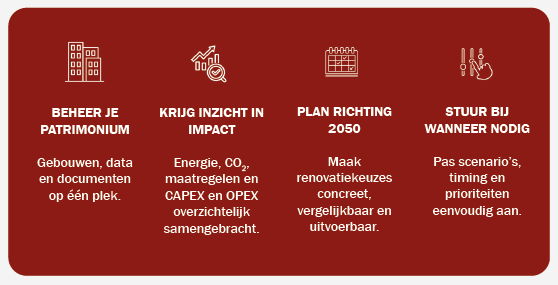
PatriQ organizes relevant building data, documents, energy consumption figures, recommendations for measures, and cost information from sources that are already available. This process highlights which data has been validated, what assumptions were made, and where information is still missing. This creates a common foundation for further analysis, with as little duplicate data entry as possible.
2. Assess measures based on their full impact
Measures are linked to their expected impact on energy consumption, CO2 emissions, CAPEX, and OPEX. Technical constraints and interdependencies are also taken into account. This clarifies the potential effects of a measure and how it relates to other possible investments within the portfolio.
3. Develop scenarios and investment paths
The potential measures are translated into comparable scenarios: which buildings should be addressed first, which measures logically go together, and how can investments be phased within the available budgets? This results in a well-founded list of priorities that includes an indicative budget impact, timeline, and contribution to energy and climate goals.
4. Update the plan when the context changes
Budgets, grants, regulations, and policy priorities are subject to change. With PatriQ, scenarios can be adjusted and reevaluated without having to rebuild the entire analysis from scratch. This ensures that the asset management plan remains a practical working tool rather than a static report.
What are the benefits?
Faster, more informed decisions
Greater control over investments, maintenance, energy costs, and CO2: CAPEX and OPEX linked to measurable impacts at the building and portfolio levels
Clear priorities across buildings and measures
Scenarios that can be easily updated
A single shared platform for technology, finance, and policy
A Better Understanding of Grant and Funding Opportunities
Would you like to know the value of your assets?
Every organization starts from a different situation. The available building information, the quality of the data, the objectives, and the investment context vary from one property portfolio to another. An initial assessment clarifies what information is already usable, where the most significant gaps lie, and which next step offers the greatest added value.
Would you like to explore how PatriQ can support your organization in assessing, prioritizing, and planning investments for your building portfolio? Please contact Ingenium to schedule an exploratory meeting.
Flemish hospitals are looking for sustainable and affordable heating solutions to reduce their reliance on fossil fuels and lower their CO2 emissions. The VLAIO Greening Scan helps them do this.
Modern regulations not only require buildings to have a management system, but also to actively monitor energy usage, detect anomalies, and utilize data to improve performance.




.jpg)