We use cookies to collect & analyze data related to the performance & usage of this website, to provide social networking functionality, and to improve & personalize our content & advertising. Learn More
We will be enjoying a well-deserved vacation from July 18 to August 2, so our offices will be closed during that time. We will be available again starting August 3.
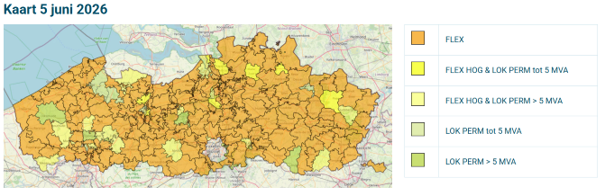
In virtually all of Flanders, traditional grid connections for large-scale consumers are no longer a given. For new or upgraded grid connections above 100 kVA, Fluvius now offers only flexible connections in the orange zones. This means that during grid congestion, you will not receive the full power your installations require. For organizations with electrification plans—ranging from heat pumps and charging infrastructure to process electrification—this is no longer a future risk but an immediate prerequisite.
Furthermore, electrifying your assets offers a competitive advantage due to the upcoming taxation under ETS 2.0. You therefore want to secure your path forward and eliminate risks. Those who fail to anticipate these changes will face obstacles to their business continuity, maintaining comfort levels, or growth plans. What does this mean in practical terms, and what is the best way to approach it?
Network Congestion: From Incident to Structural Bottleneck
The cause is well known. Data centers are growing rapidly, and the existing distribution network cannot keep up. Fluvius regularly publishes updated maps showing which areas are already under strain.
In orange zones, grid capacity is fully utilized. New or upgraded connections above 100 kVA are now only offered on a flexible basis: in the event of grid congestion, you cannot count on receiving the full capacity you requested. In other zones, a standard connection may still be possible, depending on capacity, location, and whether it is a new or existing connection.
The risk of waiting and seeing is very real. Anyone who fails to take grid constraints into account is investing in systems that cannot operate at full capacity—or will have to take costly emergency measures later on.
Several factors determine whether and when you will have sufficient funds, and what alternatives are feasible:
Grid Expansion Lead Time: An official grid study by Fluvius takes anywhere from a few weeks to a few months. The subsequent grid upgrade can take several years. For organizations with urgent replacement needs (equipment reaching the end of its service life, growth plans with strict deadlines), this creates a timing gap.
Peak power of assets: Heating systems (heat pumps, electric boilers) and cooling systems require a multiple of their average power during peak loads. This makes them a bottleneck in the electrical design.
Flexibility as a prerequisite: Flexibility is no longer optional, but the only available solution. This forces you to consider behavioral adjustments (time-shifting processes), buffering (batteries, thermal storage), or hybrid systems (fossil-fuel-based backup). Companies that can incorporate flexibility into their operations have a competitive advantage—both in mitigating grid congestion and in reducing costs.
Investment Decisions Without an Understanding of Scenarios: Battery storage, emergency generators, phased electrification, contractual flexibility—each path has its own costs, risks, and limitations. Without a clear assessment, you may invest too much in one direction or end up at a dead end.
Approach: Anticipating Grid Constraints in Four Steps
A structured approach helps you make objective decisions, justify investments, and manage timing. Ingenium uses a methodology that builds on your plans and translates them into concrete scenarios and a feasible roadmap.
Step 1 – Assess existing connections and future needs
Objective: To determine whether your current grid connection remains sufficient or when you are reaching the limit.
Approach: Ingenium analyzes your current electrical power capacity, your planned future assets (heat pumps, charging stations, process expansion, cooling), and their peak power. We identify the times (season, day, hour) when your systems are operating simultaneously.
Added value: You’ll know exactly whether and when you need an expansion, and whether it’s feasible to postpone it through phased implementation or behavioral adjustments.
Step 2 – Facilitate a grid study and analyze the grid operator’s proposal
Objective: To determine what the grid operator (Fluvius or Elia) can offer, along with the timeline and costs involved.
Approach: Ingenium assists with the application for an official grid study. We interpret the results: Will you receive a standard or flexible connection? What are the technical requirements? When can implementation begin? Which grid investments will you be responsible for paying? And what investments will you need to make in your internal electrical grid? We also identify differences in operating costs (OPEX), such as lower grid rates or capacity charges.
Added value: You avoid surprises down the road and can realistically align your investment planning with grid capacity.
Step 3 – Explore alternatives and develop scenarios
Objective: To assess which combination of measures is technically feasible, financially viable, and operationally reliable.
Approach: Ingenium models various scenarios:
Grid reinforcement: full expansion of the connection (timing, costs, dependence on the grid operator).
Emergency power generators: may be able to contribute to capacity management during grid congestion.
Battery storage: peak shaving through buffering (capital costs, service life, space requirements).
Hybrid systems: a combination of electric power and fossil fuels/biomass as a backup (transition path, CO₂ impact).
Behavioral adjustments: time shifting of processes, contractual flexibility with the aggregator (requirements: operational feasibility, convenience).
Phasing of electrification: spreading investments over several years (risk: lock-in of legacy assets).
For each scenario, we identify capex, opex, risks, timing, and dependencies.
Added value: You make your decision based on objective evidence, tailored to your business continuity requirements, budget cycle, and strategic direction.
Step 4 – Translate the decision into a design and roadmap
Objective: To ensure that the chosen solution is properly developed, approved, and implemented in phases.
Approach: Ingenium designs the comprehensive connection (if applicable), integrates batteries or hybrid systems into the electrical schematic, plans the phasing of assets, and oversees the bidding and permitting processes.
Added value: You avoid design flaws that can prove costly down the road, spread out your investments, and maintain operational control during the transition.
Result: a future-proof energy supply without operational surprises
A structured approach to grid capacity yields concrete benefits:
Continuity is guaranteed: your systems can operate as planned, without sudden outages or power shortages.
Diversified and well-founded investments: You make an informed choice between grid reinforcement, storage, hybrid systems, or phased implementation, with a clear business case for each scenario.
Risks are managed: you know in advance what the timeline, costs, and dependencies are, and you anticipate potential bottlenecks.
Future-proof assets: Your choices today align with your electrification goals for 2030–2040, without any lock-in.
Grid congestion is no longer just a technical detail, but a strategic prerequisite for any electrification project. Would you like to know what this means for your site, portfolio, or growth plans? Ingenium can help you explore the possibilities and develop a feasible roadmap. Contact us for an initial analysis of your situation.
Anyone who discovers halfway through a project that the electrical connection needs to be upgraded faces costly redesigns and months of delays. This scenario can largely be avoided with early checks.
Grid congestion threatens your energy needs: in virtually all of Flanders, large-scale consumers no longer receive the full power they need when grid congestion occurs. Don’t wait until you’re stuck—find out now how to make your electrification plans future-proof.
Many Flemish companies currently view the EBO as an administrative burden. Mandatory reporting, lots of paperwork, little inspiration. But what if we linked energy management to strategy, innovation, and competitiveness?

.jpg)


.png)
.png)