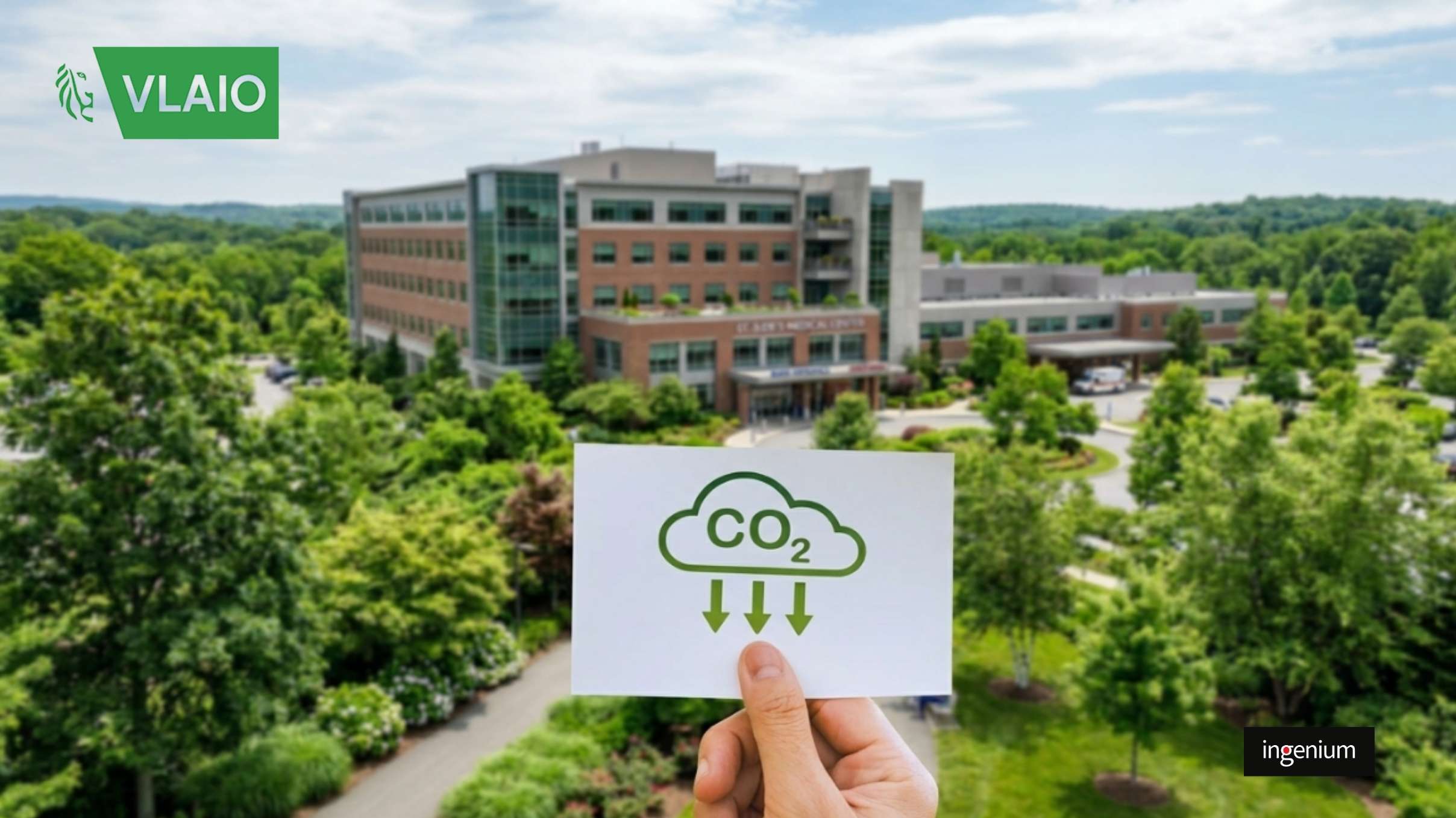
Flemish hospitals are feeling the pressure to reduce their reliance on fossil fuels, keep energy costs under control, and cut CO2 emissions. For hospital sites and larger campus facilities, this raises specific questions about (industrial) heat pumps, electric boilers, waste heat recovery, thermal storage, and heat networks connecting buildings. The technical options are well known, but the question is whether they are also feasible and affordable for your specific site. The VLAIO Greening Scan offers a structured and largely subsidized solution for exactly that.
Why act now?
For many hospitals, sustainability is no longer a standalone project, but a strategic initiative linked to energy prices, CO2 reduction, grid constraints, and future investments. VLAIO positions the sustainability scan precisely within that context: as a subsidized feasibility study for companies that want to determine whether a “green” investment makes technical and economic sense. VLAIO covers 85% of the study costs, up to a maximum of €10,000 (excl. VAT) per project.
A familiar example: a hospital with significant heat demand for domestic hot water, sterilization, and heating wants to reduce its natural gas consumption. On paper, an industrial heat pump seems like an attractive option. But additional questions immediately arise. Are the required temperature levels achievable for all applications? Is there sufficient electrical connection capacity on campus? What is the impact on peak load and operating costs? And does the investment align with the planned replacement of existing technical systems?
Without a structured analysis, there is a real risk that a measure will be implemented too soon, on too large a scale, or in the wrong form. This is a genuine concern, especially in hospitals, where safety, continuity, regulations, and budgetary timing all come into play.
What makes choosing the right green technology complex?
Choosing a green technology is rarely a simple calculation. In hospitals and other energy-intensive healthcare facilities, multiple factors come into play simultaneously.
Technical Context
Temperature levels, power demand, operating hours, and seasonal profiles determine whether a heat pump, electric boiler, or waste heat recovery system truly meets the needs of the care process or the building’s specific requirements. Applications such as sterilization, laundry, or intensive care units have specific requirements.
Operational Reality
An investment must be implementable without unnecessarily disrupting the continuity of care. Downtime, system migration periods, and integration with existing technical systems are particularly critical in a 24/7 environment.
Electrical Requirements
Grid capacity is a hard constraint on many hospital campuses. Anyone who implements electrification without fully understanding this framework risks ending up with a solution that is technically feasible but practically unworkable, especially when combined with emergency power requirements and critical loads.
Financial Logic
Capital costs, operating costs, energy price scenarios, and payback periods must be evaluated in conjunction with one another. A measure that appears attractive at first glance may turn out to be less financially sound if peak capacity, storage, or additional infrastructure are required.
Decision-Making
Hospitals often involve multiple stakeholders: technical services, executive management, healthcare management, facilities, and finance. In such cases, a technical idea alone is not enough. There is a need for a well-founded decision-making framework that builds internal support.
Typical measures that come up in such an assessment include industrial heat pumps, electric boilers, residual heat recovery, thermal storage, geothermal energy, and heat networks connecting buildings or campuses—technologies that VLAIO explicitly mentions within the framework of the greening scan.
Approach: a methodology for objectifying choices
A greening scan is most valuable when it is not approached as a separate study, but as a methodology for objectifying and phasing investments.
Step 1: Technical validation
The goal is to determine whether a proposed measure is truly suited to the hospital site. Ingenium assesses heat demand, temperature levels, electrical capacity, existing systems, and spatial constraints. The result is a clear technical framework that replaces assumptions with concrete site data.
Step 2: Economic justification
The goal is to focus the investment logic before CAPEX is committed. Investment costs, operating costs, energy price scenarios, and payback periods are calculated, possibly for multiple technology options side by side. The output is a scenario comparison that helps to avoid risks and deploy resources in a targeted manner.
Step 3: Phasing over time
The goal is to determine whether it makes the most sense to make the investment now, later, or in phases. This involves considering the investment horizon, replacement schedules, grid constraints, and potential linkages with other projects on campus. The outcome is greater certainty regarding timing, the phasing of investments, and practical feasibility.
Step 4: Translation into a usable decision document
The goal is not only to produce a study, but also to provide a guiding framework for further choices. Ingenium helps translate the results into a concrete next step: a targeted investment, a phased process, or a broader roadmap with scenarios, investment planning, and risk management. This allows the scan to be incorporated into a broader master plan, without automatically resulting in a larger process.
The financial barrier is minimal. At Ingenium, the full scan costs €11,550, excluding VAT, of which the company pays €1,732.50, excluding VAT, itself. VLAIO funds the remaining 85%, up to a maximum of €10,000, excluding VAT, per project.
New in 2026: This de minimis aid will be listed in the eAid registry, allowing hospitals to monitor their remaining aid capacity more transparently.
What are the benefits?
- Greater certainty before an investment decision is made
- Better alignment between technology, site context, and network capacity
- Reduced risk of incorrect or premature investments
- Informed choices with attention to continuity, costs, and timing
- A useful starting point for further phasing, a roadmap, or a master plan
Would you like to know what this means for your hospital site or campus organization? A sustainability assessment helps ensure that investment decisions are not made on an ad hoc basis, but rather in a well-founded and coordinated manner. Ingenium structures the technical and economic parameters, compares different scenarios, and helps determine which next step makes the most sense for your site.