

in the spotlight
Electricity
October 22, 2026
Liquid cooling is becoming crucial for AI data centers — but air remains indispensable
Why an Integrated Feasibility Study Is Critical to the Next Generation of Data Center Infrastructure

The rise of artificial intelligence is changing the way data centers are designed. Higher power densities and more powerful AI servers are putting a strain on traditional cooling systems. Liquid cooling offers an important solution, but it is not a replacement for air cooling. A thorough preliminary study is therefore a crucial step in any AI infrastructure project.
According to the International Energy Agency, electricity consumption by data centers could grow by about 15 percent annually between 2024 and 2030—more than four times faster than total electricity demand. AI workloads use specialized GPUs that deliver much more computing power per rack but also generate significantly more heat. Belgian AI data centers thus achieve power densities of 40, 100, or even 300 kilowatts per rack, compared to a much lower density in traditional environments.
Air cooling remains the trusted standard: easy to maintain and compatible with virtually all IT equipment. For traditional enterprise and cloud environments, this is still the most logical approach, offering a great deal of operational flexibility.
However, as power density rises sharply, clear limitations arise. To dissipate more heat through air, larger air volumes and more powerful fans are required, which increases energy consumption, noise levels, and the risk of hotspots. Air cooling does not disappear entirely, however: power supplies, networking equipment, and storage devices often remain air-cooled, even in a hybrid data center.
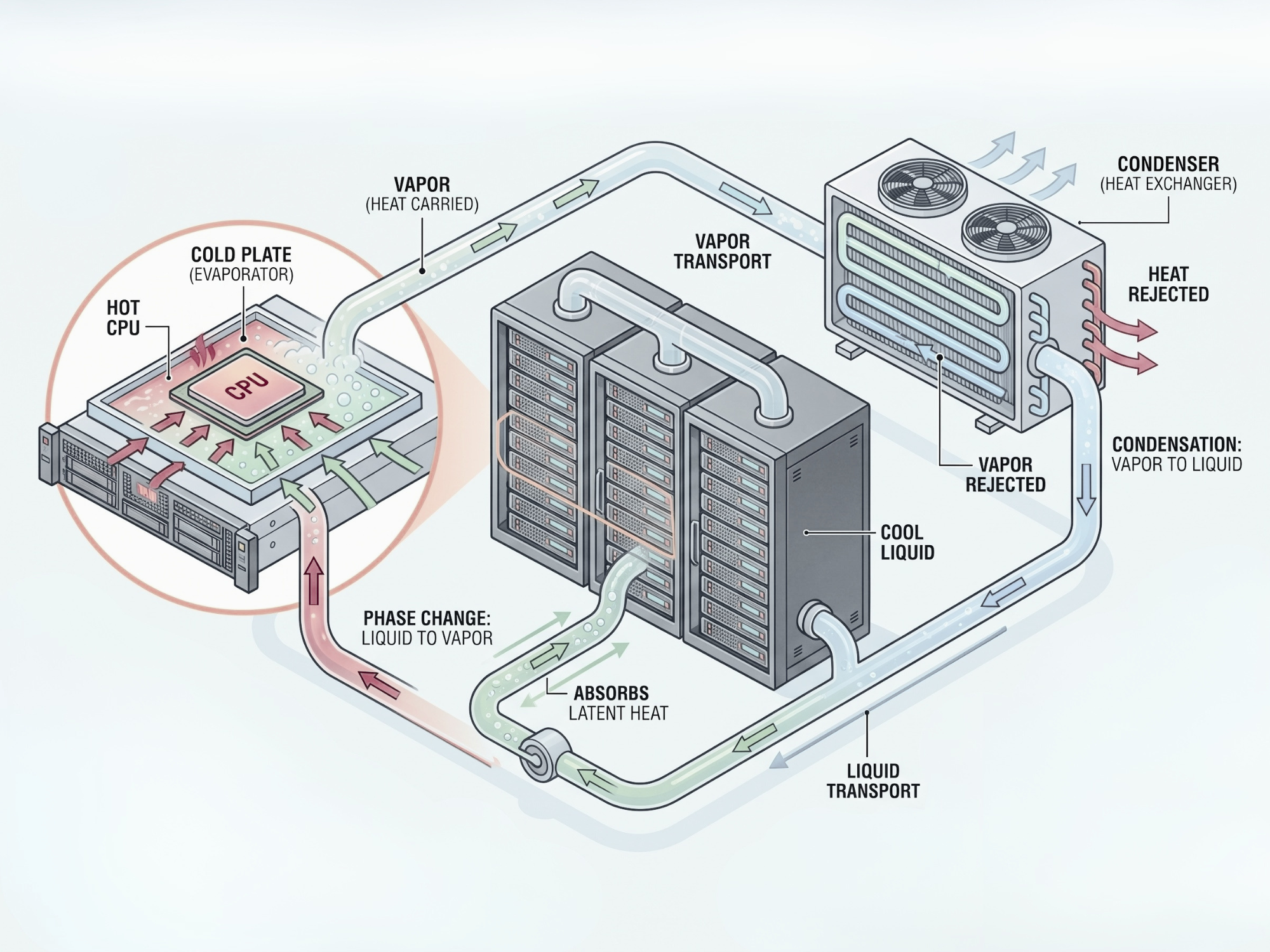
Direct-to-chip or "on-chip" liquid cooling is the most targeted form of liquid cooling for AI hardware. Instead of first dissipating heat into the ambient air, a cold plate is mounted directly onto the CPU or GPU. A closed-loop fluid circuit containing water or a coolant mixture flows through fine channels in that plate and absorbs heat exactly where it is generated—inside the chip itself.
That fluid is then routed through pipes to a Cooling Distribution Unit (CDU). The CDU regulates flow rate, pressure, and temperature, and transfers the absorbed heat to a secondary circuit that dissipates it to the outside—via dry coolers, cooling towers, or, ideally, to a heat recovery system. Because liquid can absorb significantly more heat per unit volume than air, on-chip cooling handles the extreme load of AI accelerators in a much more targeted manner and with less energy loss than an air-based system could ever achieve.
The result: higher and more stable chip temperatures are avoided, servers can be placed closer together, and the cooling water supply temperature can be higher than with conventional cooling. The latter is precisely what makes free cooling and heat recovery economically attractive. A study shows that, in a scenario with 75 percent liquid cooling, facility energy consumption can be up to 27 percent lower than in a fully air-based configuration.
Incidentally, on-chip cooling does not replace all cooling in a rack: memory, power supplies, and network cards are usually still cooled by air or rear-door heat exchangers. That is why, in practice, most AI racks use a hybrid configuration.
It is precisely at this intersection of cooling technology, energy efficiency, and sustainability that Ingenium positions itself as a consulting firm for data centers. Ingenium assists building owners in developing a comprehensive cooling strategy—from choosing between air cooling, direct-to-chip cooling, or immersion cooling to sizing CDUs, piping, and heat exchangers—tailored to the actual growth of AI workloads.
In addition, Ingenium is accredited by VLAIO to conduct greening assessments. This assessment examines the technical and economic feasibility of an investment in green technology and is subsidized up to 85 percent of the consulting costs, with a maximum of 10,000 euros per project.
For data centers, the added value lies primarily in the recovery of waste heat. Ingenium uses the sustainability assessment to specifically investigate whether waste heat from server rooms can be fed back into a local heating network, in line with Flanders’ goal of connecting data centers to collective heating systems.
A feasibility study of this kind typically identifies:
By considering cooling strategies and residual heat extraction as a single process, Ingenium ensures that a data center does not have to undergo a costly retrofit later on in order to supply heat to a district heating network.
A thorough study before the start of a project remains essential, not only to select the right cooling technology but also to avoid having to retrofit an investment after a few years. The analysis must, at a minimum, assess the current and future power density per rack, the available electrical infrastructure, the space required for pumps and heat exchangers, redundancy, and the possibilities for heat recovery.
Cooling, electrical infrastructure, and the business case are closely interrelated: a decision at one level almost always has consequences for the other levels. That is why it is important to take an integrated, systems-oriented approach rather than simply comparing technical specifications.
Liquid cooling will play an increasingly important role in AI and HPC data centers, but it is not a silver bullet. The most forward-thinking data centers first analyze their workloads, rack densities, and growth scenarios, and then determine where air cooling is sufficient, where liquid cooling becomes necessary, and how residual heat can be reused.

