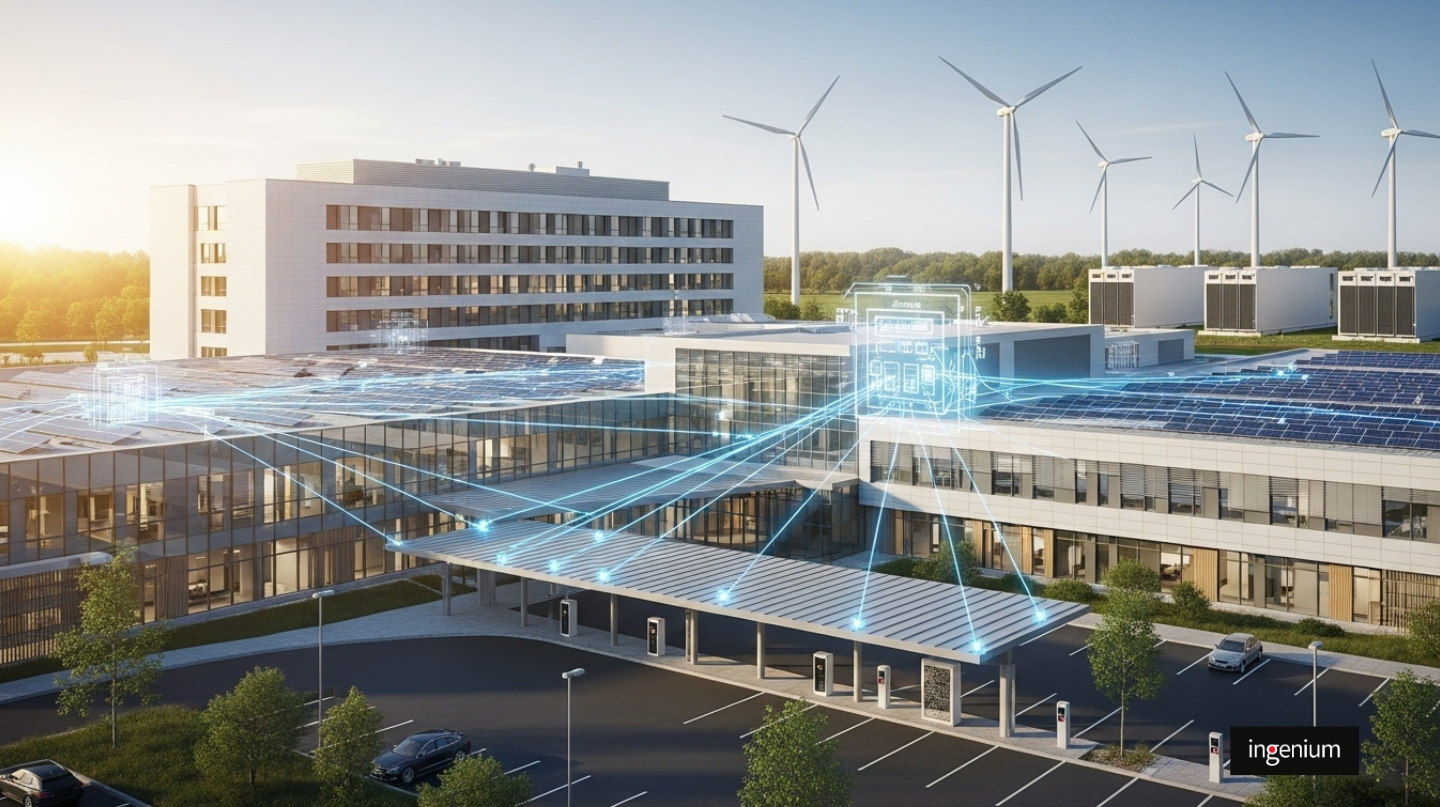
The energy transition is in full swing, but it is anything but linear. Hospitals are faced with increasing electricity consumption, fluctuating energy prices, and instability in the energy market, where negative prices can arise when excess power from solar panels is injected into an overloaded grid. Hourly prices vary greatly, grid capacity is becoming scarcer, and geopolitical tensions are causing uncertainty about security of supply. In this uncertain energy market, hospitals are forced to respond quickly and flexibly to changes.
The hospital of the future therefore requires a flexible and robust energy infrastructure, not only to ensure sustainability, but also to guarantee continuity of care, even during grid failures or unexpected price fluctuations. In this context, energy flexibility is no longer a luxury, but a strategic tool that enables hospitals to control costs, limit risks, and even create new value.
By responding to trends such as electrification, market dynamics, security of supply, and cybersecurity, energy flexibility can form a crucial foundation for both cost optimization and risk management. This not only gives hospitals more control over their energy consumption, but also contributes to their sustainability and future resilience.
From fixed customer to flexible dynamic energy player
Companies that manage their energy smartly can actively respond to price fluctuations and market signals. This is done through:
- Shifting consumption to times when prices are lower
- Using buffers or storage to smooth out peaks
- Temporarily reducing or postponing processes that do not have a direct impact on continuity
- Participating in energy markets such as mFRR (manual Frequency Restoration Reserve) or aFRR (automatic Frequency Restoration Reserve) for additional income
Flexibility does not require a complete system overhaul, but often starts with optimizing existing assets: HVAC installations, heat pumps, electric boilers, thermal or electrical storage, charging infrastructure, or production processes with some leeway in terms of time.
Smart steering requires insight and structure
The real leverage comes when these assets are integrated into an energy management system (EMS) that automates control based on real-time data and market signals. This creates a dynamic energy system that:
- optimizes consumption,
- avoids peaks,
- and monetizes flexibility.
A well-developed EMS enables links to dynamic energy tariffs, intelligently controls buffer capacities, and anticipates grid limitations. Control is exercised entirely within the limits of operational continuity and comfort.
Technical preconditions are essential
It is essential for hospitals to have a solid technical foundation in order to ensure energy flexibility. This means:
- A robust internal electricity network that offers sufficient capacity and growth opportunities to reliably support both current and future energy needs, such as for heat pumps and charging stations.
- Clear guidelines for prioritizing critical care functions in the event of power outages or capacity issues, ensuring that vital departments remain operational regardless of the situation.
- Reliable backup systems, such as batteries or additional generators, that can be quickly deployed to ensure continuity of care in the event of malfunctions.
- Strict digital security measures for energy management, which comply with applicable guidelines such as NIS2, to prevent cyberattacks from disrupting energy supplies or healthcare systems.
Together, these elements form the basis for a future-proof energy system in hospitals, which both guarantees continuity of care and contributes to cost savings and sustainability.
In short, flexibility is not just about saving costs or generating income. First and foremost, it must contribute to reliable and continuous healthcare provision.
From cost to opportunity
By approaching energy not merely as a fixed cost, but as an actively manageable flow, organizations can:
- reduce their energy expenditure through better timing and smart control,
- increase their operational resilience in the event of network problems,
- and generate income through flexibility markets or supplier agreements.
With good management, flexibility becomes not only a technical necessity, but also a business opportunity.
Flexibility therefore offers opportunities to reduce energy expenditure. Conversely, energy flexibility offers an opportunity to strengthen the reliability of the electricity grid in a cost-effective manner. For many hospitals, providing emergency power across the entire campus represents a significant investment. However, when those emergency power generators also generate flexibility income, the business case becomes considerably more attractive—and it becomes almost self-evident to quickly provide the entire campus with emergency power.
Ingenium as a flexible partner in energy optimization and strategy
Ingenium assists companies and institutions in making strategic choices by drawing up a future-oriented energy master plan and developing a future-proof energy concept. We analyze existing infrastructure, identify potential for flexibility, and design a phased route to a smart, scalable, and robust energy system. Energy flexibility is not only the answer to grid congestion or price spikes—it is a lever for better policy, lower costs, and greater operational reliability.
Our approach is well-founded and tailored to the realities of today and tomorrow.